I thought I was weak
As part of Letters to the World, we create space for honest, unfiltered patient experiences. This letter from YASJC member, Sabine (Germany), explores self-doubt, identity, and what it means to live with chronic illness over time.
Sabine (Germany)
3/26/20264 min read
You would think, given my role and history in community advocacy, that I would have no qualms with my identity or who I am.
But echoes, whether old and distant or new and loud, of what others have said still ring in my head.
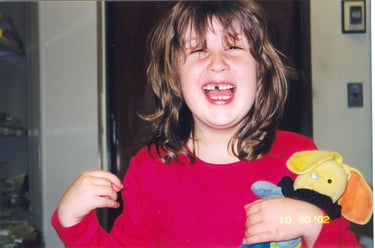
I’ve been collecting diagnoses since I was a kid. I never quite felt like the other children, but - even then - I’d be damned if I was going to let them know.
I remember asking my friends to turn around during our state physical exam when it was my turn to do pull-ups. I told them I had performance anxiety. In reality, I just struggled to perform. I just didn’t have a name for why.
I remember seeing a specialist as a child who told me that if I felt sick from heat or exercise, I should stick my face in a bowl of cool water.
But the diagnoses I remember really started in my teens.
First, I stopped eating because of gastrointestinal distress. Celiac disease.
“Haha, how silly, I’m such an adventurous eater otherwise,” I’d say.
Then the migraines started.
College came and went. One year I struggled to walk, and it became harder to hide. I added EDS, atrophic endometrium, ADD, and anxiety to the list.
“Haha, look how bendy I am,” I’d say, doing the same performative party trick with my hands whenever people asked how I was doing.
“Sabine, you are still treating this like it is acute when you need to get used to it being chronic,” a college professor told me nearly a decade ago.
I tried a support group once in graduate school. A girl in her late teens in a wheelchair. Another in her early twenties on an all-liquid diet.
How can you accept this? I remember thinking.
I was angry, not at them, but at their doctors. How could you do this to them?
But they were happy.
And I spent so much time thinking about what others thought of me that I never realized, and often still don’t, how much I judge myself. Or maybe it isn’t judgment. Maybe it’s self-loathing.
“Wow, this looks like…” my first allergist paused while reviewing my records.
“What?” I asked.
She hesitated.
“You were going to say lupus, weren’t you?”
She admitted that she was. When patients like me collect diagnoses, it often points to something bigger.
But it wasn’t lupus.
The list continued to grow throughout graduate school. POTS, Raynaud’s, MCAS, eczema and eventually ankylosing spondylitis.
And with the growing list came growing embarrassment.
It became harder to hide the frequent doctor visits. Whenever I was asked about it in public, I felt myself wince.
I remember even the things that weren’t said to me.
I remember a girl crying because she told her PhD advisor she had depression. They told her to keep it to herself.
To be both a woman and have a condition in STEM meant not showing weakness.
Am I weak? I thought.
Do they know I am weak?
I wish I could end this letter by saying that I now know I am not weak. That I am strong.
But even now, in my 30s, I am still not used to it.
I’ve moved back to the country where my family lives and have been navigating a new healthcare system, one that doesn’t believe in some of my diagnoses.
“I am sorry to say, but I think your US doctors under-treated you,” said in the same conversation as, “Let’s take you off your medication and see what happens.”
I knew what he was implying. Under-treated. Overmedicated. Given diagnoses he didn’t believe in. Too young to feel like this. That the labels were thrown at me just to placate me.
Or maybe I was reading too much into it, because I had heard it all before.
If I had been younger, I might have agreed. I wanted so badly not to be unwell that I often wondered if it was all psychosomatic, attention-seeking even.
Sometimes I still wonder if I am just weak.
If I am exaggerating.
If I am making it all up.
“No,” I said.
“I know what happens without my medication.”
- Sabine (Germany)
Living with Ankylosing Spondylitis


Enhancing quality of life for young people with chronic skin and joint conditions across Europe through advocacy, education, and community support.
© 2026. All rights reserved.